
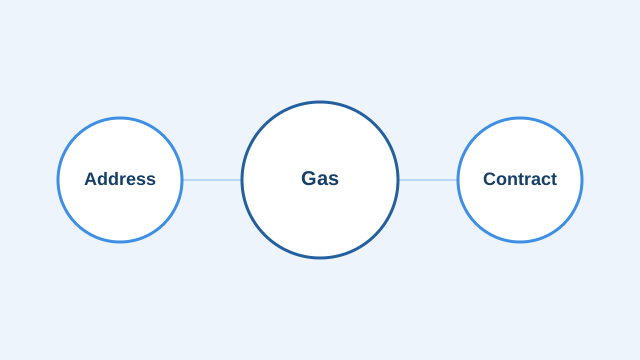
Build the core mental model
EVM Networks is easier to use when EVM and address are understood in the same operational context. The EVM is an execution environment for smart-contract bytecode. Multiple networks can be EVM-compatible while still having different chain IDs, fee assets, blocks, and risk conditions. An address identifies an on-chain account or contract. Address formats can look similar across networks, so appearance alone is not enough to confirm the destination network. These situations are rarely improved by clicking faster; separate the object, permission, and expected result instead.
To go further with EVM Networks, separate three questions: what object is involved, what action is being requested, and where the result can be verified. EVM provides one decision point, while address connects that decision to actual on-chain state. If those layers do not line up, resolve the uncertainty before signing or broadcasting.
Practical checkpoint
- Do not let a familiar address format replace checks of the network name, chain ID, or contract deployment.
- Recheck the leading and trailing characters, destination network, and asset type; a small test transfer can reduce uncertainty for important transactions.
- Before any transfer, signature, or approval, confirm that the network, address, and request details match the action you intended.
Connect the concept to on-chain data
EVM Networks is easier to use when gas and smart contract are understood in the same operational context. Gas measures computational work for on-chain execution, and the actual fee can vary with network conditions and operation complexity. A high or low fee does not prove that a transaction is safe. A smart contract executes rules according to deployed code and on-chain state. A wallet can summarize a call, but the user should still understand the target contract and important parameters. Understanding the boundary is more important than rushing to completion because on-chain actions can create difficult-to-reverse outcomes.
To go further with EVM Networks, separate three questions: what object is involved, what action is being requested, and where the result can be verified. gas provides one decision point, while smart contract connects that decision to actual on-chain state. If those layers do not line up, resolve the uncertainty before signing or broadcasting.
Practical checkpoint
- Separate the network fee, transfer amount, and contract call details instead of focusing only on the fee number.
- Verify the contract source, called method, asset changes, and permission changes; do not blindly sign for an unfamiliar contract.
- Before any transfer, signature, or approval, confirm that the network, address, and request details match the action you intended.
Understand related mechanisms
EVM Networks is easier to use when token and token approval are understood in the same operational context. Tokens are commonly represented by smart-contract rules. Tokens with the same name may exist on different networks or come from different contracts, so a name or icon alone is not proof of authenticity. A token approval allows a specified contract to use a token within an allowance. It is not a normal login step, and an excessive allowance or incorrect target increases exposure. Putting these concepts together is more useful than memorizing vocabulary without knowing when a check matters.
To go further with EVM Networks, separate three questions: what object is involved, what action is being requested, and where the result can be verified. token provides one decision point, while token approval connects that decision to actual on-chain state. If those layers do not line up, resolve the uncertainty before signing or broadcasting.
Practical checkpoint
- When relevant, verify both the network and contract address, and distinguish native assets from contract-based tokens.
- Verify the spender contract, token, allowance, and necessity, and consider revoking approvals that are no longer needed.
- Before any transfer, signature, or approval, confirm that the network, address, and request details match the action you intended.
Risk boundaries and what to learn next
EVM Networks is easier to use when EVM and address are understood in the same operational context. The EVM is an execution environment for smart-contract bytecode. Multiple networks can be EVM-compatible while still having different chain IDs, fee assets, blocks, and risk conditions. An address identifies an on-chain account or contract. Address formats can look similar across networks, so appearance alone is not enough to confirm the destination network. In practice, the useful habit is to match what the interface shows against the network, address, and actual request details.
To go further with EVM Networks, separate three questions: what object is involved, what action is being requested, and where the result can be verified. EVM provides one decision point, while address connects that decision to actual on-chain state. If those layers do not line up, resolve the uncertainty before signing or broadcasting.
Practical checkpoint
- Do not let a familiar address format replace checks of the network name, chain ID, or contract deployment.
- Recheck the leading and trailing characters, destination network, and asset type; a small test transfer can reduce uncertainty for important transactions.
- Before any transfer, signature, or approval, confirm that the network, address, and request details match the action you intended.
Keep seed phrases and private keys under your own control. Do not send them to anyone. Review the address, network, amount, signature text, and approval scope before confirming. Third-party DApps and smart contracts can introduce independent risk.